


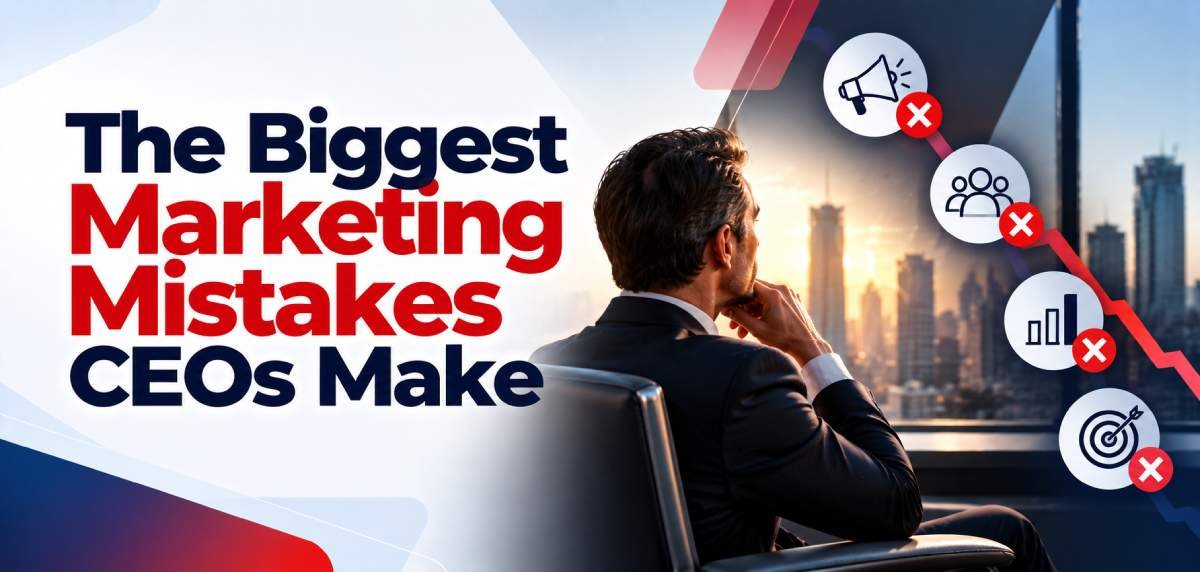
The Biggest Marketing Mistakes CEOs Make
In today’s rapidly changing digital business world, marketing is not just an auxiliary function that handles advertising, social media and email campaigns. Marketing is among the key drivers behind the growth of companies. Effective marketing takes care of customer discovery, value realisation, belief in the marketing claim, product selection, and loyalty to the company brand.
Marketing choices may have a great impact on growth, revenue quality, customer acquisition costs and the positioning of technology-driven companies for their CEOs. But many leaders are making marketing mistakes that may be seemingly insignificant at first glance, yet create great trouble in the future. These errors result in misused budgets, poor brand awareness, unqualified leads, inconsistent communication and slower growth.
CEOs do not make these marketing mistakes due to a lack of intelligence and ambition; they do them because marketing is perceived as a short-term process and not as a part of a broader business process. Even though a company has a great product, an excellent team and a good vision of what it does, it will fail to communicate its importance to consumers due to poor marketing.
At Jetaads, we help organisations develop effective marketing strategies that support sustainable growth. Our professional services cover strategy, branding, content, paid media, campaigns, and execution. Rather than marketing tools or software products, we apply our marketing expertise to help organisations achieve their growth goals.
Treating Marketing as an Expense
One of the worst marketing missteps that CEOs commit is viewing marketing solely as an expense. In times when finances tighten, marketing is among the first to suffer budget reductions. Managing expenses is a good idea, yet doing it without understanding the implications on future revenue can lead to negative results.
Marketing provides awareness prior to customers getting to the point of purchase. Marketing plays a major role in selling, communicates value to potential customers, generates authority and maintains the visibility of the brand. The absence of investments in marketing will save the company some money now while causing missed opportunities in the following months.
However, the aim is not to waste more money without having a strategy in mind. Instead, the aim is to invest efficiently and get results for the investment. One should understand whether there is a generation of qualified leads, conversions, pipeline value, increased trust of customers, and decreased cost per acquisition through marketing efforts.
Marketing is one of the best investments in sustainable demand.
Focusing Only on Immediate Leads
The importance of leads cannot be overestimated, but a sole concentration on lead generation at the very moment might damage a company’s marketing in the long term. Not all marketing efforts are oriented towards immediate inquiry.
For instance, a piece of useful information such as an article, technical guide, video material, or industry insights can have no conversions right away, but it can help potential customers realise a problem, see an expert in the sphere, and recall the brand when making their choice.
Modern-day buyers do not always follow the path from seeing an ad to purchasing a product right after that. Instead, they can watch a social media post at first, visit a website later, read a blog, download a guide, talk about possible solutions internally, and get back to the company after several weeks or even months.
Thus, it is crucial for CEOs to combine lead generation with branding. While paid campaigns can attract existing demand, content creation, positioning, and thought leadership will create new demand in the future. Companies that do not pay attention to their brand may become too dependent on paid acquisition and suffer from high advertising costs.
Assuming a Great Product Will Sell Itself
While a quality product has value, its mere existence does not guarantee customer demand for it. Many CEOs, particularly those with an engineering mindset, think that consumers will see the value of a product because it is a solution to their actual problem. But consumers cannot pick a solution without understanding it.
Marketing translates product features into customer benefits.
A technical team may focus on integrations, automation, security, infrastructure, dashboards, or advanced functionality. Customers usually focus on different questions. They want to know whether the service will save time, reduce cost, solve a pressing challenge, improve results, or make their work easier.
When messaging is too technical or unclear, potential customers may leave without understanding what the company actually offers. This can happen even when the product itself is highly capable.
CEOs need to ensure that their marketing expresses the value of the company through
straightforward and assertive messaging. These messages must clarify the target audience of the service, the problems being solved, the importance thereof, and the results to be achieved.
At Jetaads, we help businesses simplify complicated offers to create effective marketing messages. Our professional services are tailored towards ensuring that brands deliver their value in a simpler way.
Not Understanding the Ideal Customer
Broad targeting is also one of the quickest ways to squander your marketing budget. When a business attempts to appeal to all, it usually appeals to none in particular.
CEOs often refer to their customers in rather general terms like business owners, startups, enterprises, developers, and digital companies. While these references may be useful, they are too vague for effective marketing efforts.
An ideal customer profile should go deeper. It should cover what kind of business it is, who will make the decision, its pains and problems, its objectives, its challenges, the urgency of its needs and why it might be reluctant to purchase.
For instance, there may be two businesses which appear quite alike, but one is going to be a potentially profitable customer for you whereas the other would just be doing research without any need to proceed.
The CEOs must keep themselves updated with customer dialogues. Getting involved in customer calls, learning from customer feedback and doing customer analysis, as well as knowing why they stay and why they leave, gives great insight into marketing.
The better a company knows its target market, the easier it will become for them to create messaging and run campaigns accordingly.
Chasing Every Marketing Trend
New platforms, AI capabilities, content formats, and digital trends appear constantly. It can be tempting for CEOs to push their teams to be everywhere at once. However, trying every trend often creates scattered marketing instead of meaningful growth.
A new channel is not automatically valuable because it is popular. It is valuable only if the company’s audience is active there and the channel supports a specific business objective.
A company might find itself wasting time crafting content for several different platforms, starting too many marketing campaigns on too many channels, and embracing all emerging trends without establishing consistency anywhere. Such activities lead to low-quality execution, poor analytics, and an active team that is not productive.
Instead, one should start by identifying several key channels and focusing efforts there first. One should come up with a consistent marketing strategy, craft quality content, analyze results, and optimize campaigns. After one finds success with one channel, they can scale their efforts further.
AI technology can help in marketing activities as well. In particular, AI could be useful for market research, creating marketing content, analysing the target audience, providing analytics, and optimising campaigns. At the same time, one should remember that AI will not be able to replace strategic thinking.
Measuring Vanity Metrics
Marketing reports usually showcase many followers, views, impressions, clicks, likes, and engagement. However, while the above indicators may appear to be useful, they should not be considered the sole indicator of success in the view of the CEO.
Thousands of clicks on the campaign do not necessarily mean that clicks have converted into leads, customers, and even repeat customers. In the same way, though a post may prove to be engaging, it does not ensure that the post is useful if it is not viewed by the target market.
Moreover, CEOs must pay attention to the metrics that link marketing targets to business targets. These KPIs could be leads, conversion rate, sales pipeline, cost of acquiring customers, revenue generated, retention, lifetime value of customers, and deal velocity.
It is hard to provide accurate marketing attribution since the customer can come into contact with the brand across multiple channels before making a purchase. However, it is important for a company to develop a measurement framework.
Marketing, sales, and executives must establish what a good lead looks like, what funnel
stages there are and what metrics are more important.
Separating Marketing From Sales
Marketing and sales should work toward the same revenue goal. When they operate separately, the customer journey becomes inconsistent.
Marketing may generate leads that sales considers weak. Sales may not share common customer objections with the marketing team. Campaigns may promise one thing, while sales conversations focus on something else. Over time, this creates lost opportunities and internal frustration.
It is important for CEOs to foster ongoing collaboration between sales and marketing. The marketing team needs to know how the leads are being converted. The sales team needs to have access to valuable material such as messaging and campaign details. Sales and marketing should also exchange information regarding client requirements, objections, delayed purchases, and effective conversion.
If there are too many demo requests but not enough customers, the issue could lie in messaging, follow-up, price discussion, onboarding, and even a disconnect between the advertising and the sales process.
When there is collaboration between sales and marketing, they can pinpoint where the problem lies and optimise the overall customer experience.
Conclusion
The most common mistakes of CEOs when it comes to marketing are usually gradual ones. These are strategic weaknesses that hinder future growth by approaching marketing as an expense, pursuing only quick leads, expecting that the product will sell itself, going too broad, jumping on every trend, tracking vanity metrics, and separating sales from marketing.
Marketing involves much more than running marketing campaigns. This process needs proper customer knowledge, strategic positioning, measurement, communications, and dedication to trust-building.
While there is no need for CEOs to learn how to manage marketing campaigns, they should treat marketing as a strategic growth tool.
jetaads helps businesses grow using marketing strategies that include professionalism, strategic thinking, creativity, performance and sustainable growth. We don’t sell marketing tools and software. We help businesses develop better marketing campaigns, messaging, customer experience and marketing systems that drive actual business outcomes.