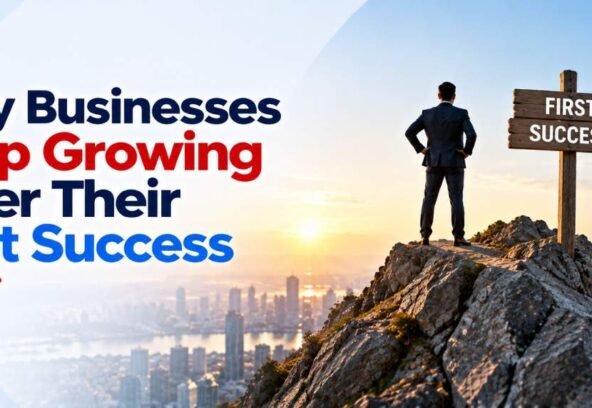




Why Businesses Stop Growing After Their First Success
Reaching your first important milestone is a sign that you have figured out how to do things. However, for many tech-enabled organisations, reaching that milestone becomes an obstacle in itself and not a platform from which to grow further. Progress stalls and the strategy used to get you here fails to work anymore.
The reality is that in most cases, it’s not poor market conditions or wrong timing that is at fault, but internal obstacles related to strategic, operational, and leadership issues.
In this article, we will talk about what causes a company to plateau after its first success and how a strategic partner such as Jetaads can help overcome those obstacles.
The Early Win Trap: When Success Becomes a Ceiling
Hustle, intuition, and execution by the founder usually pay off in early success. You make sales via your network; deliver features by listening directly to customers; and remain lean by doing everything yourself. But not forever.
After reaching a certain size, the same actions that got you here will hold you back. Decisions get bottlenecked at the founder’s desk. Informal processes break under increased load. And the market, now more competitive and discerning, demands consistency, specialisation, and strategic clarity that ad-hoc execution can’t deliver.
This isn’t a failure of effort. It’s a failure of evolution. The systems, structures, and leadership approaches that served a 10-person startup rarely work for a 50- or 100-person organisation. Without intentional redesign, growth naturally plateaus.
Strategic Drift: Losing the Narrative That Drove Early Growth
Initially, your value proposition is crisp: You fix a particular problem for a targeted audience. However, as you try to find other ways to increase income, venture into related markets, or counter competition, you risk losing this focus.
Strategic drift occurs whenever your business activities do not reflect your story anymore. You can develop unnecessary functionalities, target people outside your ideal customer persona, and muddy up your message to reach everyone. The consequence will be confused consumers, extended sales funnels, and low conversion rates.
The tech-savvy crowd punishes lack of precision the most. They have high standards for clarity of their positioning, product roadmap, and launch strategy.
Jetaads works with leadership teams to re-anchor strategy in evidence and customer reality. Through structured discovery and market validation, we help clarify where to play, how to win, and what to stop doing—so growth efforts compound instead of cancel each other out.
Operational Debt: The Hidden Cost of “Just Ship It”
Speed is everything for young businesses. You launch fast, iterate constantly, and patch problems that crop up along the way. However, such a strategy inevitably creates technical debt. This is the inefficiency and fragility of systems that cannot be scaled as customers grow.
As the number of users increases, the cracks appear. Support tickets multiply. Onboarding takes longer. Engineering wastes time putting out fires rather than engineering. The company might be growing, but it’s getting less profitable.
The irony? Many leaders recognise these issues but deprioritise them in favour of “growth activities.” They assume operations will “sort itself out” once revenue hits the next milestone. It rarely does. Instead, operational friction becomes the invisible brake on expansion.
Jetaads helps companies audit and redesign their operating model for scale. We don’t implement generic playbooks. Instead, we map your unique value chain, identify constraint points, and co-create lightweight but robust processes that support sustainable growth without sacrificing agility.
The Founder Bottleneck: When Leadership Becomes the Limit
Most likely, the biggest challenge that companies face when they struggle and cannot move forward is called the “Founder bottleneck.” When a company is small, the ability of its founder to have a great vision, to establish great connections and to be able to make decisions is crucial.
However, when the company starts growing, and all big decisions, all big hires and strategic changes depend on the decision of the founder, things start slowing down. Teams start waiting for their instructions, innovation stops because risks are centralised, and, at last, the founder himself becomes unable to work on the strategy of the future since he spends too much time working on other matters.
In order to overcome the challenge, founders need to change themselves and learn how to be leaders who delegate tasks to people rather than do things themselves.
Jetaads supports this transition through executive coaching and leadership architecture design. We help founders clarify their unique role at scale, establish decision rights, and build leadership teams that can operate independently—freeing the founder to focus on vision, culture, and long-term strategy.
Channel Saturation and the Illusion of Product-Market Fit
For many companies, success in acquiring early users means that the company has found product-market fit. These companies get their first hundred users from a combination of referrals, outbound efforts, and social media. However, such channels may face some limitations at some point.
First, word-of-mouth becomes irrelevant after exhausting the immediate network. Second, organic channels become difficult after changes in the algorithm. Third, paid user acquisition may cost too much due to high competition.
The deeper issue? Many companies haven’t stress-tested their value proposition across different segments or channels. What appealed to early adopters might not be appealing to the broader customer base. Without conducting proper tests, you won’t know which factors actually lead to growth.
At Jetaads, we help teams go past being channel-reliant by conducting growth experiments, testing messages within different segments, and creating feedback loops that will impact product and marketing decisions.
Cultural Stagnation: When “What Got Us Here” Becomes Dogma
Culture is more than perks or vision statements. Culture is the unwritten playbook that influences the way things get done. During periods of rapid growth, culture typically celebrates speed, heroism, and personal drive. But it can also derail scalability.
If “just figure it out” is the standard way of doing business, there will be issues with onboarding and a lack of institutional knowledge. If it glorifies individual contribution over team success, collaboration will suffer. And if it insists on “the way we’ve always done it,” innovation won’t happen.
Cultural stagnation is particularly dangerous since it goes unnoticed until turnover rises, internal collaboration breaks down, or certain projects stall.
The Jetaads’ experts work with organisational leaders to detect cultural pain points and ensure behavioural alignment with strategic objectives. We don’t force the company into adopting an existing model of culture. Instead, we work together to develop norms that will enable the next phase of growth and build a system of rituals, incentives, and communication practices around them.
Breaking Through: The Role of Strategic Consulting in Sustained Growth
Growth does not have to involve working harder or faster in the recruitment process. It is about making sure that your strategy, processes, and managerial approach are suited to your degree of complexity. This is where strategic consulting truly shines.
Unlike software vendors or templated accelerators, firms like Jetaads offer human-centred, context-aware guidance. We don’t sell tools. We sell clarity—helping you see the real constraints holding you back and co-create solutions that fit your unique situation.
This process is collaborative and iterative. First, we analyse your readiness for growth along dimensions such as strategy, operations, leadership, and culture. Then we focus on those interventions that offer maximum leverage—be it reframing your market entry strategy, clarifying decision rights, or developing feedback systems to ensure alignment with your customers’ needs.
The outcome isn’t just a plan. It’s a new operating rhythm—one that turns growth from a sporadic achievement into a repeatable capability.
Why Generic Advice Fails—and What Works Instead
Most business content offers universal prescriptions: “Hire a sales team,” “Double down on content,” or “Automate everything.” But these tactics ignore context. What works for a B2B SaaS company with enterprise buyers won’t work for a developer tools startup selling to individual engineers.
The advice is not helpful because it addresses only the symptoms, but not the problem itself. It presumes that the bottleneck is related to the environment around your company—such as market trends, your competitors, or your budget—but, in reality, the bottleneck can be something else, like misalignment of incentives or wrong decision-making patterns.
Our methodology at Jetaads does not include such cookie-cutter recommendations because we first discover what is really going on inside your business through interviews and mapping out your workflow.
The Jetaads Difference: Partnership Over Products
While the world is caught up in software stacks and automation systems, Jetaads is unique in that it concentrates on what really counts – human judgment and organisational structure.
We don’t sell subscriptions or licenses. We sell outcomes—measurable improvements in growth velocity, team alignment, and leadership capacity. Our involvement is limited yet revolutionary because we want you and your company to be able to grow even after we’ve left.
When our clients reach us, they do so because something has stopped working. They have added people, money on advertisements, and features, but to no avail. What they need isn’t another tool. It’s a partner who can see the system, not just the symptoms.
That’s where Jetaads adds value. We bring decades of collective experience scaling tech companies across markets and stages. We’ve seen what works, what doesn’t, and why. And we apply that knowledge not as consultants who dictate answers, but as collaborators who co-create solutions with you.
Conclusion: Growth Is a Discipline, Not a Destination
Yet success can be deceiving. It creates a false sense of security and makes us think that everything will just work out. The reality is that growth requires continuous repositioning – strategic, structural, and mental.
Companies do not cease growing because they have run out of ideas. They cease growing because they lack the systems and leadership capable of delivering on their ideas in an expanding way. And the silver lining is that these barriers are solvable if we get the right help.
The very existence of Jetaads is meant to provide it for tech companies. We assist in strategic consulting, leadership development, and business design to ensure sustainable growth for you.
And if you’ve been feeling stuck after the initial breakthrough, well, there’s no shame in it. And there is nothing you should feel stuck about. Because your next growth phase is waiting for you.