


Emotional Marketing vs Rational Marketing: What Works Best for Tech Brands?
Technology marketing mostly involves marketing in terms of features, specs, integrations, dashboarding, security certification, benchmarking performance, and pricing. However, there will always be someone at the back end of every technological purchase looking for a solution, minimising risks, increasing efficiency, or growing their business.
That is the reason that the difference between emotional marketing and rational marketing is everything. Emotional marketing guarantees that the target market identifies with the brand, and rational marketing ensures that they have all the facts in order to be able to buy into it.
Emotional messaging creates interest and relevance. Rational messaging provides evidence and confidence. Together, they can guide a prospect from discovering a brand to evaluating its services and taking action.
What Is Emotional Marketing?
Emotional marketing relies on emotions, human experience, and storytelling to affect the way customers perceive a brand. Rather than just telling what a particular offer can do, emotional marketing conveys reasons why this offer is generous for a customer.
Instead of emphasising aspects such as threat detection and network protection, a cybersecurity provider may also emphasise the peace of mind that a customer feels due to a higher level of business protection. Rather than speaking of its services of storage and computing capacity, a cloud service provider may focus on the benefits of scaling without disruption that a business gets due to its use.
In tech marketing, the emotional message does not have to be dramatic and exaggerated. Emotions may be quite pragmatic and unobtrusive. For example, emotions may be related to relief after automating processes, excitement after releasing a new product, or confidence that comes due to decision-making based on data provided.
Rather than asking “What does this technology do?”, emotional tech marketing asks “What does it make you feel and how does it affect you?”
The importance of this distinction comes from the fact that marketing a product on the basis of its features may cause all products to become very similar to each other. As all companies talk about artificial intelligence, automation, analysis, and integration, they would not be differentiated through repetitive use of technical terms. Emotional positioning gives those features a human context.
For instance, “automated reporting” is a feature. “Give your team more time to focus on strategic growth instead of compiling reports” communicates the benefit behind that feature.
What Is Rational Marketing?
A rational marketing strategy is driven by logic, facts, and rational decisions. It gives an explanation for why and how to use certain logic and facts in order to come up with reasonable choices.
Case studies, performance, pricing, technicalities, services offered, timing, testimonials, security, and comparison are among the key components of the rational marketing strategy. This approach allows customers to understand what they are purchasing and their expectations.
Rational marketing plays a very important role in technology since, in many cases, there might be several parties involved. The marketing manager will analyse the performance of the campaign, the financial specialist will study its cost-effectiveness, while the technical specialists will analyse the reliability and security of the solution.
Each party will ask its own question. For instance, the finance department will be interested in whether or not it is possible to earn on the purchase, the technical department will need to see how the solution will fit into the current environment, and the business owner will look for some proof of long-term support.
Rational messaging answers these questions. It explains what an offer includes, how it works, how performance will be measured, and why it may be a better option than competing alternatives.
Although rational marketing is based on facts, it does not have to feel cold or impersonal. Clear information creates trust. When a technology brand explains a complex subject in a transparent and accessible way, it reduces uncertainty and makes the buying process feel safer.
Emotional Marketing vs Rational Marketing
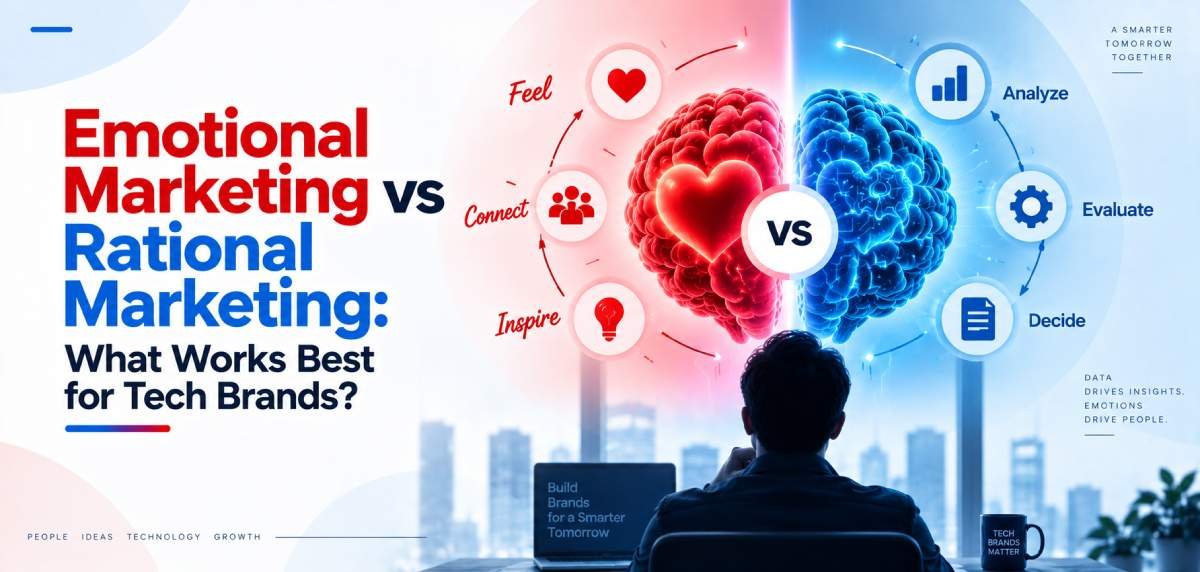
The basic difference is simple: emotional marketing creates connection and desire, while rational marketing provides justification and proof.
Emotional marketing is often used to make a brand memorable. Rational marketing helps make an offer understandable and defensible. Emotional messages help audiences care about a problem or opportunity. Rational messages help them evaluate whether the proposed solution is credible.
These approaches should not be treated as opposites. Effective technology campaigns connect them. A message might begin by showing the emotional benefit of helping a business operate with greater confidence. It can then explain the expertise, strategy, process, and results that make this benefit believable.
Imagine a digital marketing agency promoting campaign management services. A rational message might say:
“Improve campaign efficiency through audience segmentation, conversion tracking, creative testing, and performance optimization.”
This provides useful information, but it may not be especially memorable. An emotionally informed version might begin with:
“Stop wondering where your marketing budget is going.”
That message connects with a common frustration: uncertainty. The rational explanation can then show how tracking, testing, and optimization help solve the problem.
Emotion creates relevance, while logic creates confidence. The two approaches are most effective when they support the same customer outcome.
Why Emotion Matters in Technology Marketing
Technology buyers are often assumed to make decisions based only on data. In reality, even highly technical purchases involve emotion. Buyers may feel pressure to avoid failure, concern about choosing the wrong provider, frustration with inefficient processes, or ambition to gain a competitive advantage.
These feelings affect attention and decision-making before a prospect studies a technical specification.
A company searching for an analytics solution may encounter many providers offering dashboards, reports, artificial intelligence, and real-time data. A feature-focused message may disappear among similar claims. However, a message about giving teams the confidence to make important decisions from one clear view of the business may feel more relevant.
Emotional marketing also supports brand recall. Technology buyers encounter advertisements, articles, videos, product pages, and sales messages throughout the day. A campaign built only around generic features may be forgotten quickly. A strong story, distinctive point of view, or authentic understanding of the customer’s challenge can make a brand easier to remember.
Emotion can also help create differentiation. Two companies may offer similar services but represent very different experiences. One may position itself as the partner that brings clarity to complex growth challenges. Another may focus on innovation, speed, reliability, or operational control. These associations influence how audiences interpret the brand.
Why Logic Matters in Tech Marketing
While emotion draws attention, technology sales involve rational facts. Although the prospect may like the brand’s stories, he should know whether the company can fulfill its promise.
Rational marketing makes general statements into specific facts that back up those promises. The company may declare that it assists its customers to grow, and the prospect wants to know how. Strategy, execution, reporting, tracking, optimization, and past results could become topics of interest.
It is even more crucial when buying involves big budgets or several decision-makers. The prospect should be able to convince his management or even the finance department of this proposal.
Rational marketing is required when buying a product that touches upon issues of security, business continuity, or performance. Here, the buyers are interested in the risks involved, the implementation process, timelines, and responsibilities of the parties.
Otherwise, emotional marketing may look rather vague. The slogan “transform your growth” sounds appealing, but it is hard to judge without an understanding of the nature of this transformation.
Using Both Approaches Across the Buyer Journey
The proportion of emotional to rational marketing must vary during the process of the buyer’s journey.
In the first stage of awareness, emotional marketing could be useful for a technology brand in order to attract attention. Since the audience has not started looking for a solution to their problem yet, the message needs to resonate with some frustration, goal or ambition that they have. Thought leadership, storytelling, videos and problem-driven marketing campaigns could help achieve that.
During the second stage of consideration, both approaches must be combined. The buyer has already become aware of the problem. Content should explain the recommended approach while continuing to communicate the desired business outcome. Case studies, educational articles, webinars, and expert insights are useful because they combine human context with practical information.
At the decision stage, rational proof often becomes more important. Prospects may examine pricing, service scope, timelines, expected deliverables, reporting processes, and previous performance. Emotional trust still matters, but the customer needs enough detail to approve the investment.
Even after conversion, emotional marketing plays a vital role in retaining the customer as well as advocacy. It is vital for the customer to be satisfied with his choice and for his provider to know what he wants. Communication, reporting, and knowledge can play a major role here.
How Jetaads Supports a Balanced Strategy
Experience in digital marketing, online marketing, performance marketing, media buying, branding, affiliate marketing, and data-driven growth is what Jetaads brings to the table. The main focus of their services revolves around delivering brands to customers who meet the target audience in a better way.
The experience is important when a brand is expected to have an emotional position as well as rational discipline of performance. The brand might want to communicate its message, yet at the same time, it must know how to target, test creatives, track conversions, retarget, report and optimise the process for measuring the outcome.
For a technology company, Jetaads can help translate complex services into communication that is easier for decision-makers to understand. The emotional layer may focus on greater confidence, improved efficiency, reduced friction, or stronger growth. The rational layer can explain the strategy, execution, measurement, and optimization behind those outcomes.
It is important to clarify that Jetaads offers professional services only. Jetaads does not sell tools or software products. Jetaads works with clients for their professional expertise, strategic input, execution of campaigns, media buying, performance marketing, branding, and other digital marketing services. This is because the value is generated not through the purchase of a platform, but through expertise and execution.
Creating Stronger Tech Campaigns
A practical way to combine emotional and rational marketing is to follow the structure “outcome first, evidence second.”
Start by communicating the meaningful change the customer wants. Then explain the method, proof, and next step.
For instance, an advertisement for a performance marketing program may start out by saying “Say goodbye to all the guesswork about your campaigns that generate growth.” That strikes at the core of the problem and the need to take more control. The copy may further explain how audience targeting, conversion tracking, creative optimisation, and analysis can tell what makes a difference in terms of performance.
Finally, the call to action may be inviting the prospect to consult an expert on the subject or get a review of their campaigns. That’s how emotional connection and reasoning lead to an action step.
That approach also works for SEO and content marketing. The article should really touch upon the pain points of the readers, rather than try to stuff in some keywords about features. A case study should tell the customer’s story while using data to demonstrate credibility.
The technology brand should experiment with various ways to communicate its message. There is a possibility that certain target audiences might favour language that inspires aspirations, while other target groups might focus on benchmarks, prices, and implementation of products. Performance should not be measured only by the number of clicks. Depending on the goal of the marketing campaign, the performance indicators might vary.
Conclusion
It is wrong to treat emotional marketing and rational marketing as mutually exclusive options. Emotional marketing will help technology brands get noticed, remembered and trusted. Rational marketing will help customers understand the deal, consider its risks and prove it was the right choice.
For tech audiences, the best approach is a blend of both. Start with the result for the person or business, and then back it up with evidence, transparency and proof. Appeal to emotions with storytelling to bring complicated technologies to life and use rational facts to convince them.
Jetaads will help brands unite the psychology of target audiences and the performance of campaigns with professional digital marketing services, such as online advertising, performance marketing, media buying, branding, affiliate marketing and data-driven campaign management. Jetaads only provides professional services without offering marketing tools or software.
It is just that easy: engage people with the opportunity, provide them with a rational basis to believe in it and make the next move obvious.